Major and minor scales form the foundation of almost all Western music. Understanding the difference between them is one of the most important steps in learning music theory, playing by ear, writing songs, or improvising.
This guide clearly explains what major and minor scales are, how they are built, how they sound, how they relate to each other, and how to use them in real music.
What Is a Scale?
A scale is a series of notes arranged in a specific pattern of whole steps (tones) and half steps (semitones). The pattern determines the scale’s unique sound and emotional character.
The two most common types in Western music are the major scale and the minor scale.
The Major Scale
The major scale is the most familiar scale in Western music. It generally sounds bright, happy, stable, and resolved.
Formula (pattern of steps):
W – W – H – W – W – W – H
(Whole, Whole, Half, Whole, Whole, Whole, Half)
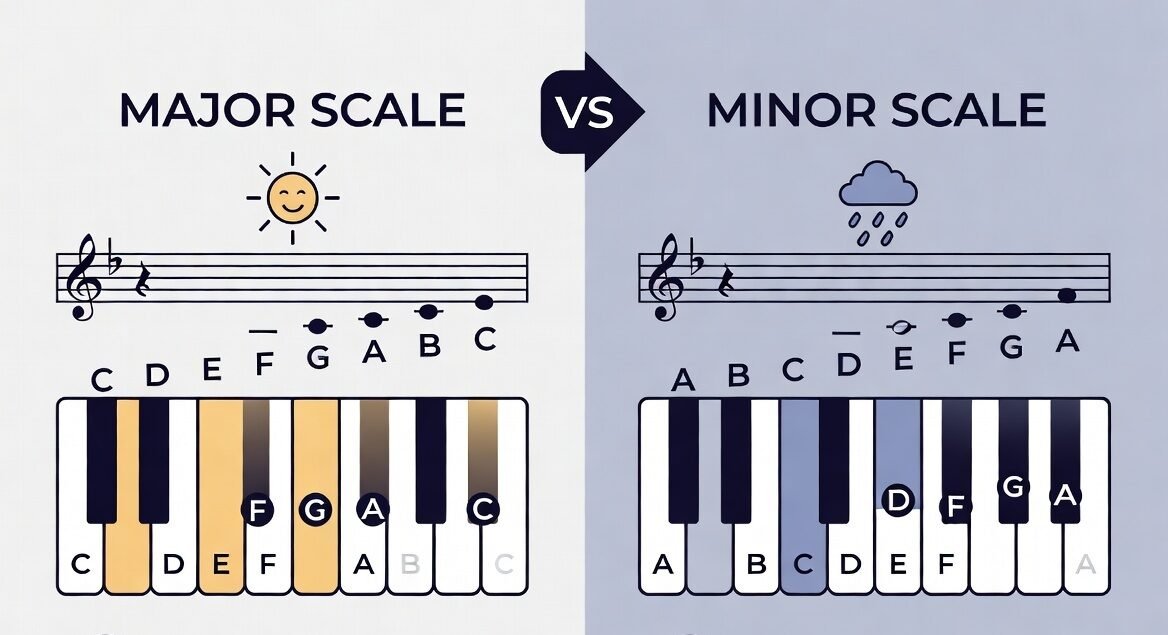
Example – C Major Scale:
C – D – E – F – G – A – B – C
Key characteristics of the major scale:
- The third note is a major third above the root (this is what gives it the “major” sound).
- The seventh note is a major seventh (leading tone), which strongly pulls back to the root.
- It forms the basis of major chords and major key signatures.
The Minor Scale
Minor scales generally sound darker, sadder, more emotional, mysterious, or serious compared to major scales.
There are three common forms of the minor scale:
1. Natural Minor Scale (Aeolian Mode)
This is the basic form of the minor scale and the relative minor of a major scale.
Formula:
W – H – W – W – H – W – W
Example – A Natural Minor:
A – B – C – D – E – F – G – A
2. Harmonic Minor Scale
This version raises the 7th degree to create a stronger leading tone (useful for classical and dramatic music).
Formula:
W – H – W – W – H – W+H – H (or 1½ steps between 6 and 7)
3. Melodic Minor Scale
This version raises both the 6th and 7th degrees when ascending (and often reverts to natural minor when descending). It is commonly used in classical and jazz contexts.
For most beginners, the natural minor is the most important form to learn first.
Key Difference: The Third Degree
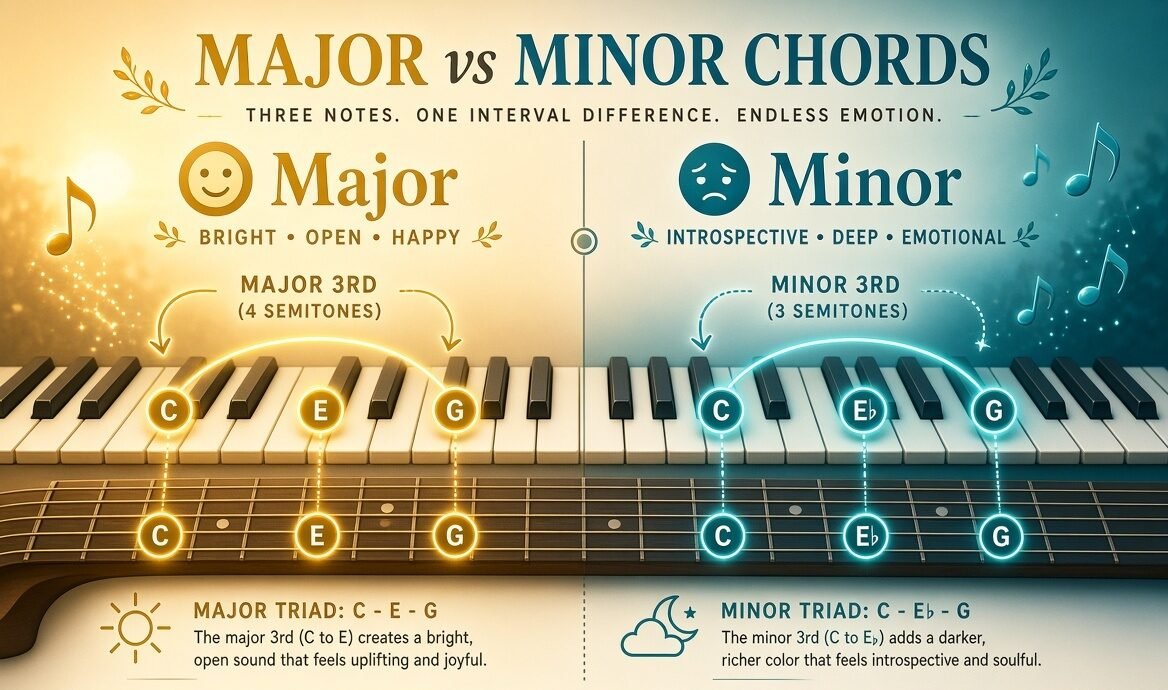
The single most important difference between major and minor is the third note of the scale:
- Major scale → Major 3rd (brighter sound)
- Minor scale → Minor 3rd (darker sound)
You can often identify whether a piece is major or minor simply by listening to the quality of the third.
Relative Major and Minor
Every major scale has a relative minor that uses exactly the same notes (and the same key signature) but starts on a different root.
- The relative minor starts on the 6th degree of the major scale.
- Example: C major and A minor share the same notes.
C major: C D E F G A B C
A minor: A B C D E F G A
To find the relative minor of any major key, go down a minor third (three half-steps) from the major root.
To find the relative major of any minor key, go up a minor third.
Parallel Major and Minor
Parallel major and minor scales start on the same root note but have different notes.
Example:
- C major: C D E F G A B C
- C minor (natural): C D E♭ F G A♭ B♭ C
These sound more contrasting because they share the same tonic but different scale degrees.
Comparison Table
| Feature | Major Scale | Natural Minor Scale |
|---|---|---|
| Emotional character | Bright, happy, stable | Darker, sad, emotional, mysterious |
| Formula | W W H W W W H | W H W W H W W |
| 3rd degree | Major 3rd | Minor 3rd |
| 6th degree | Major 6th | Minor 6th |
| 7th degree | Major 7th (leading tone) | Minor 7th |
| Relative example | C major | A minor |
| Parallel example | C major | C minor |
How to Use Major and Minor Scales
- Major scales are common in pop, country, folk, classical, and uplifting music.
- Minor scales appear frequently in rock, blues, metal, film scores, ballads, and emotional songs.
- Songwriters often switch between a major key and its relative minor to change mood without changing the notes.
- When improvising, matching the scale to the underlying chord quality (major or minor) creates strong, consonant solos.
Quick Tips for Beginners
- Start by learning the C major and A natural minor scales thoroughly — they use only white keys on the piano.
- Practice singing or playing both scales slowly and listen carefully to the difference in the third note.
- Learn the relative major/minor pairs together (they share the same key signature).
- Use a keyboard or instrument to compare parallel major and minor scales starting on the same note.
- Apply what you learn by identifying whether songs you know are in major or minor keys.
Final Thoughts
Major and minor scales are two sides of the same musical coin. The major scale feels bright and resolved; the minor scale feels deeper and more emotional. Once you understand their formulas, the role of the third degree, and the relationship between relative keys, you unlock a huge amount of musical understanding.
Practice both types regularly, listen actively to music around you, and experiment with switching between major and minor versions of the same melody. This simple contrast is one of the most powerful tools in all of music.
Start with C major and A minor today — your ear (and your playing) will thank you.