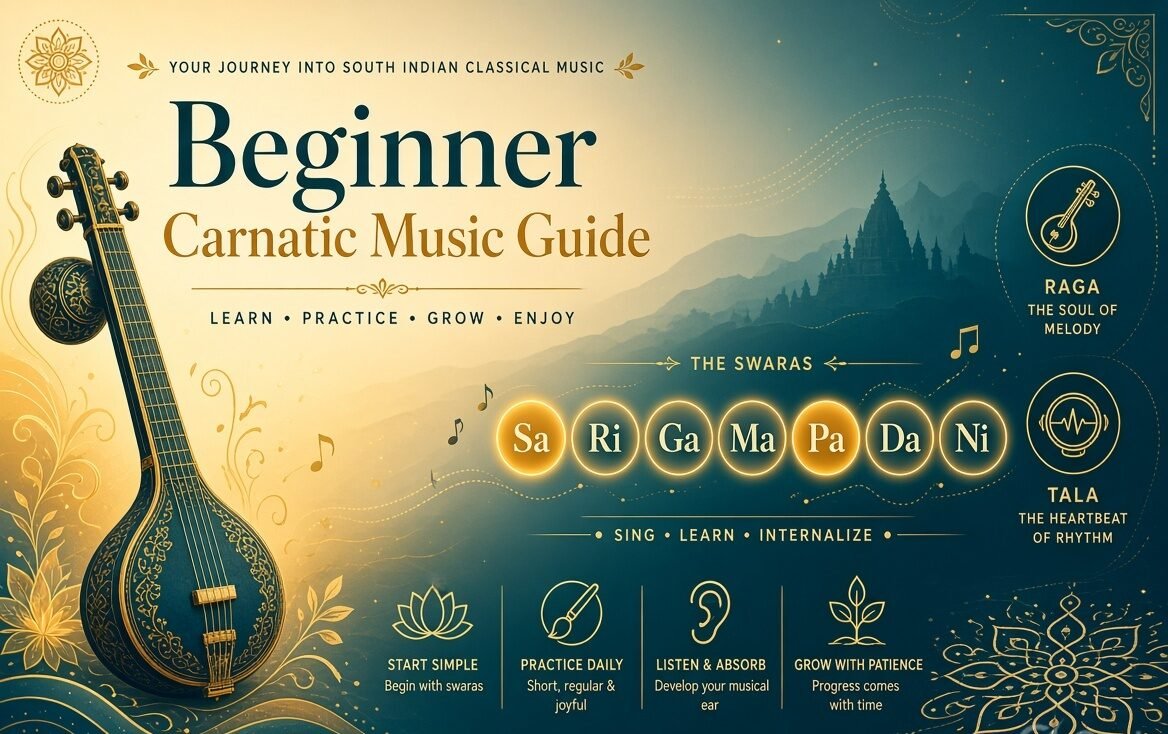
Carnatic music is the classical music tradition of South India. It is known for its intricate melodies (ragas), complex rhythmic cycles (talas), and rich improvisational tradition. Whether you want to sing or play an instrument, this guide gives you a clear, structured starting point.
What Is Carnatic Music?
Carnatic music is one of the two main classical music systems of India (the other is Hindustani from North India). It emphasizes:
- Precise pitch (shruti)
- Melodic frameworks called ragas
- Rhythmic cycles called talas
- A balance of composition and improvisation
It is traditionally learned through a guru-shishya (teacher-student) system and follows a highly organized progressive curriculum.
The Building Blocks
1. Swaras (Notes)
There are seven basic notes, called the Sapta Swaras:
| Swara | Full Name | Western Equivalent (approx.) |
|---|---|---|
| Sa | Shadja | Do / C |
| Ri | Rishabha | Re |
| Ga | Gandhara | Mi |
| Ma | Madhyama | Fa |
| Pa | Panchama | Sol |
| Da | Dhaivata | La |
| Ni | Nishada | Ti |
These notes can have variations (for example, different types of Ri, Ga, Da, Ni), creating the 12 swara sthanas (note positions) within an octave.
2. Shruti (Pitch)
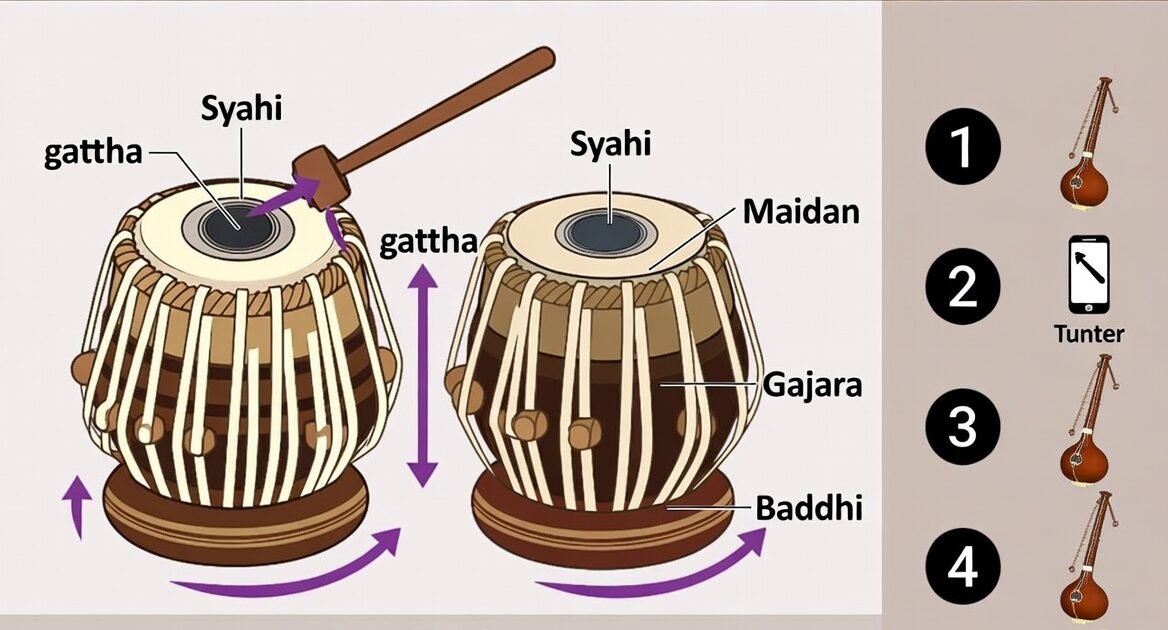
Shruti is the foundational drone or reference pitch. In practice, a tanpura or electronic shruti box provides a continuous Sa-Pa (or Sa-Ma) drone. All singing and playing is done relative to this fixed tonic.
3. Raga
A raga is a melodic framework with specific ascending (arohana) and descending (avarohana) note patterns, characteristic phrases, and emotional character. There are 72 parent scales called Melakarta ragas, from which thousands of janya (derived) ragas are formed.
Beginners usually start with simple ragas such as Mayamalavagowla, Mohanam, or Shankarabharanam.
4. Tala
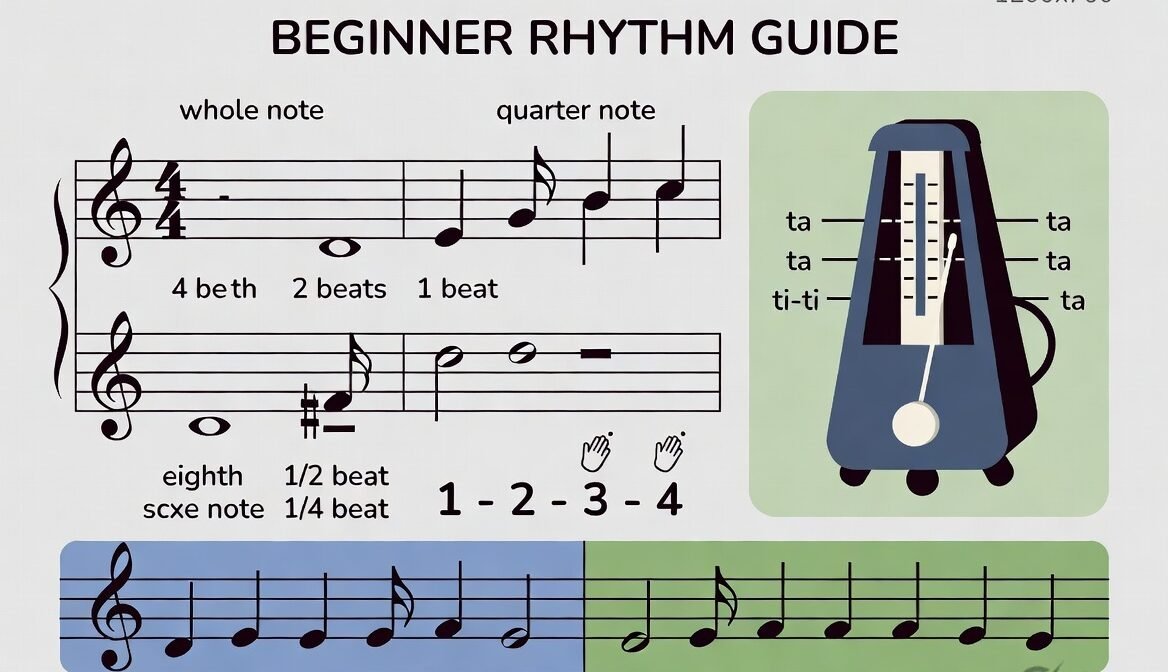
Tala is the rhythmic cycle. The most common beginner tala is Adi Tala (8 beats). Other basic talas include Rupaka, Triputa, and others. Students learn to keep tala with hand gestures (claps, waves, and finger counts).
The Traditional Learning Path for Beginners
Carnatic training follows a time-tested sequence created centuries ago (notably systematized by Purandara Dasa):
- Sarali Varisai – Simple ascending and descending note patterns
- Janta Varisai – Double-note patterns (Sa-Sa, Ri-Ri, etc.)
- Dhatu / Tatu Varisai – Zigzag and skip-note patterns
- Melsthayi & Mandrasthayi Varisai – Higher and lower octave exercises
- Alankaras – Patterns set in different talas
- Geethams – First simple songs with lyrics
- Swarajatis – Slightly more complex compositions
- Varnams – Advanced technical pieces that combine melody, rhythm, and lyrics
Only after these foundations do students move to full kritis (compositions) and improvisation (alapana, neraval, swara kalpana).
Essential Practice Tips for Beginners
- Always practice with a shruti box or tanpura app.
- Focus on accurate pitch (hitting the exact swara sthana) before speed.
- Keep tala steadily — use hand gestures or a metronome set to the tala cycle.
- Practice daily, even if only 20–30 minutes.
- Sing slowly and clearly at first; speed comes later.
- Listen actively to great artists to absorb the style and gamakas (ornamentations).
Common Beginner Mistakes
- Rushing through basic varisais without perfecting pitch
- Ignoring tala while focusing only on melody
- Singing without a continuous shruti reference
- Trying to learn complex songs too early
- Neglecting voice culture and breath control
Recommended First Steps
- Get a reliable teacher (in-person or online) if possible.
- Set up a shruti box or app at a comfortable pitch for your voice.
- Begin with Sarali Varisai in the raga Mayamalavagowla (the traditional starting scale).
- Learn to keep Adi Tala properly.
- Listen daily to simple geethams and beginner-friendly kritis.
Instruments in Carnatic Music
While vocal music is central, popular instruments include:
- Veena
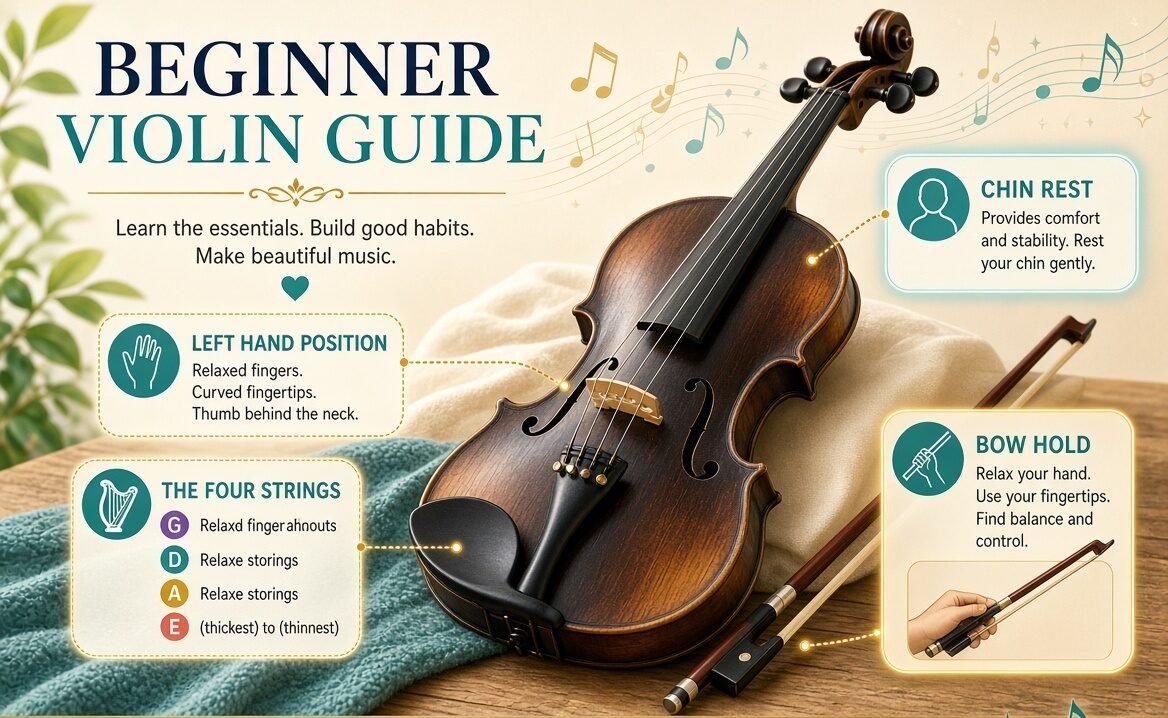
- Violin (adapted to Carnatic style)
- Flute (bansuri/venu)
- Mridangam (percussion)
- Ghatam, Kanjira, Morsing
Many students learn vocals first even if they later take up an instrument.
Final Thoughts
Carnatic music rewards patience, consistency, and deep listening. The early stages may feel repetitive, but the basic exercises (varisais and alankaras) build the pitch accuracy, voice control, and rhythmic sense that everything else depends on.
Start slow, stay regular, respect the traditional sequence, and enjoy the process. With steady practice, you will gradually unlock the beauty, complexity, and emotional depth that make Carnatic music one of the world’s great classical traditions.
Shubh aarambham — a happy beginning on your Carnatic journey!