Proper tabla tuning is essential for clear tone, accurate pitch, and musical expression. A well-tuned tabla produces the characteristic bright “Na” and “Tin” on the dayan and deep, responsive bass on the bayan. This complete Tabla Tuning Guide explains everything beginners need to know to tune their instrument correctly and safely.
Understanding the Tabla Pair
A tabla set consists of two drums:
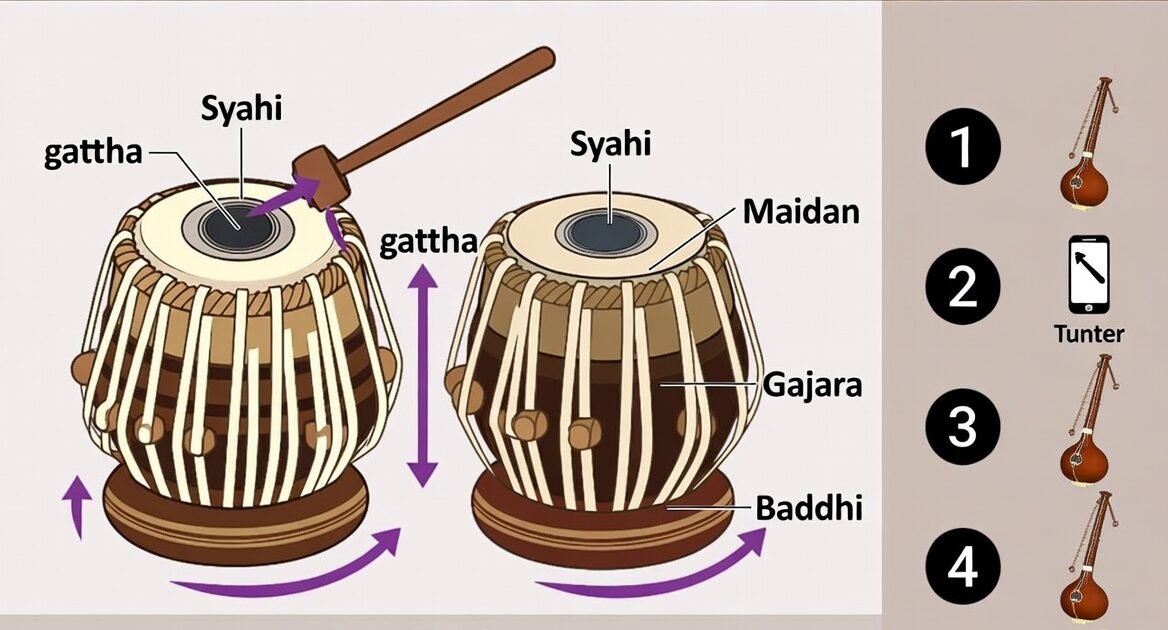
- Dayan (right-hand drum) – Wooden shell, higher pitched, tuned to a specific musical note (usually Sa).
- Bayan (left-hand drum) – Metal shell (brass or copper), lower pitched, used for bass and pitch modulation with the heel of the hand.
The black circular patch in the center of both heads is called the syahi (or gab). It is critical for tone and should never be struck with the hammer or cleaned with water.
Tools You Need
- Special tabla tuning hammer (hathori / dhawni)
- Chromatic tuner app (GuitarTuna, ClearTune, or similar)
- Reference pitch source (tanpura app, harmonium, or electronic drone)
- Soft ring or cushion to place the drums on
- Patience and a quiet space
Choosing the Right Pitch
The dayan is almost always tuned to the tonic note (Sa) of the raga or composition being played.
Common pitches for beginners and students:
- C
- C#
- D
Your teacher or the melody instrument will determine the exact pitch. The bayan does not need a precise fixed pitch — it should simply have even tension so it responds well to palm pressure.
How to Tune the Dayan (Right Drum)
Follow these steps carefully:
1. Set a reference pitch
Play your chosen Sa on a tanpura app or harmonium and keep it sounding while you work.
2. Check the current pitch
Strike a clear “Na” (edge stroke) or “Tin” (center stroke) at several points around the rim. Use the tuner app to see the note.
3. Coarse tuning with the gattha (wooden blocks)
There are usually 8 cylindrical wooden blocks (gattha) wedged between the straps and the shell.
- To raise the pitch → Hammer the gattha downward.
- To lower the pitch → Hammer the gattha upward.
Work in opposite pairs (1 and 5, 2 and 6, 3 and 7, 4 and 8). This keeps the head tension even and prevents dead spots.
4. Fine tuning on the gajara (braided rim)
Once you are close to the target note:
- Strike the gajara downward to raise the pitch slightly.
- Strike upward from underneath the gajara to lower the pitch.
Always hit the middle of each leather segment and avoid the skin and the syahi.
5. Check evenness all around
Play “Na” or “Tin” at 8–12 points around the rim. All points should sound the same pitch with a clear, ringing tone and no “waves” or beating sound. Adjust any uneven spots by working on the nearest gattha or gajara section.
6. Final verification
Play open strokes and listen. The note should be stable, pure, and match your reference Sa. Wait a few seconds after each adjustment for the head to settle.
How to Tune the Bayan (Left Drum)
The bayan is simpler:
- Ensure the straps are firm but not overly tight.
- Insert or move gattha if the head feels too loose.
- Check that the tension is even around the rim by playing open “Ge” strokes.
- The goal is smooth pitch bending when you apply and release palm pressure. Buzzing or jumping usually means uneven tension.
Important Safety and Care Tips
- Never strike the syahi or the playing surface with the hammer.
- Work in small increments — aggressive hammering can damage the head or straps.
- Always maintain even tension by adjusting opposite sides.
- Keep the tabla at room temperature. Extreme heat, cold, or humidity will pull it out of tune.
- New heads stretch and need frequent retuning for the first few days.
- Store the drums with the heads protected and away from direct sunlight.
Common Beginner Mistakes
| Mistake | Result | Solution |
|---|---|---|
| Hammering only one side | Dead spots, uneven tone | Always work in opposite pairs |
| Hitting too hard | Damaged straps or head | Use controlled, light taps |
| Checking pitch immediately | Inaccurate reading | Wait 2–3 seconds for the tone to settle |
| Ignoring the bayan | Weak bass response | Ensure even tension on both drums |
| Using a regular household hammer | Risk of damage | Use a proper tabla hammer |
Practice Routine for Stable Tuning
- Tune before every practice session.
- Retune after 10–15 minutes of playing (the head warms up and pitch rises slightly).
- Record the target pitch in your tuner app for consistency.
- Learn to recognize the pure “standing” tone versus a wavy, out-of-tune sound.
Final Thoughts
Tabla tuning is both a technical skill and an ear-training exercise. At first it may feel slow and frustrating, but with regular practice it becomes faster and more intuitive. A well-tuned tabla responds beautifully, projects clearly, and makes learning bols and compositions much more enjoyable.
Start slowly, keep the tension even, match your reference Sa carefully, and protect the syahi. Once your tabla is in tune, you will immediately notice the difference in tone quality and musical expression.
Happy practicing!