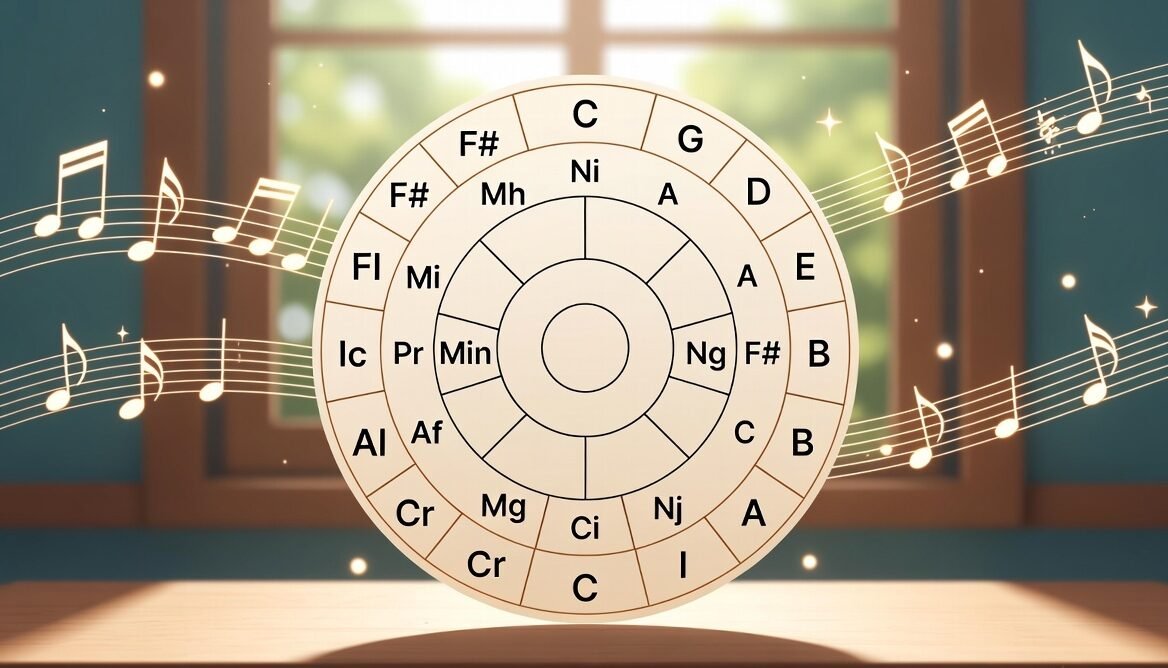
The Circle of Fifths is one of the most powerful and practical tools in music theory. It organizes all 12 major and minor keys into a simple circular diagram that reveals key signatures, chord relationships, and harmonic movement at a glance. Once you understand it, writing songs, transposing music, and finding related chords become dramatically easier.
This complete guide explains what the Circle of Fifths is, how it is built, how to read it, and the most useful ways musicians actually use it.
What Is the Circle of Fifths?
The Circle of Fifths is a visual map of the 12 tones of Western music arranged so that each key is a perfect fifth away from the next.
- Moving clockwise = ascending perfect fifths (and adding sharps)
- Moving counter-clockwise = ascending perfect fourths (and adding flats)
A perfect fifth is the interval spanning seven half-steps (for example, C to G).
C major sits at the top (12 o’clock position) because it has no sharps or flats. From there the circle flows naturally through every key and returns to C.
How the Circle Is Organized
Outer ring: Major keys
Inner ring: Relative minor keys (which share the exact same key signature)
Clockwise from C (sharps side):
- C major / A minor → 0 sharps
- G major / E minor → 1 sharp
- D major / B minor → 2 sharps
- A major / F♯ minor → 3 sharps
- E major / C♯ minor → 4 sharps
- B major / G♯ minor → 5 sharps
- F♯ major / D♯ minor → 6 sharps
- C♯ major / A♯ minor → 7 sharps
Counter-clockwise from C (flats side):
- F major / D minor → 1 flat
- B♭ major / G minor → 2 flats
- E♭ major / C minor → 3 flats
- A♭ major / F minor → 4 flats
- D♭ major / B♭ minor → 5 flats
- G♭ major / E♭ minor → 6 flats
- C♭ major / A♭ minor → 7 flats
At the bottom of the circle, keys can be spelled enharmonically (same pitch, different name), such as F♯ major = G♭ major.
Order of Sharps and Flats
The Circle of Fifths also shows the exact order in which accidentals appear:
Order of sharps (clockwise):
F♯ – C♯ – G♯ – D♯ – A♯ – E♯ – B♯
Mnemonic: Father Charles Goes Down And Ends Battle
Order of flats (counter-clockwise):
B♭ – E♭ – A♭ – D♭ – G♭ – C♭ – F♭
Mnemonic: Battle Ends And Down Goes Charles’ Father (the reverse)
Practical Ways to Use the Circle of Fifths
1. Instantly Find Key Signatures
Count how many steps a key is from C:
- Clockwise = number of sharps
- Counter-clockwise = number of flats
2. Find Relative Minors and Majors
The relative minor of any major key sits directly inside it on the inner ring (or three steps clockwise on the outer ring).
Example: Relative minor of C major is A minor. Relative major of E minor is G major.
3. Build Strong Chord Progressions
The most important chords in any key sit next to each other on the circle:
- The key itself = I (tonic)
- One step clockwise = V (dominant)
- One step counter-clockwise = IV (subdominant)
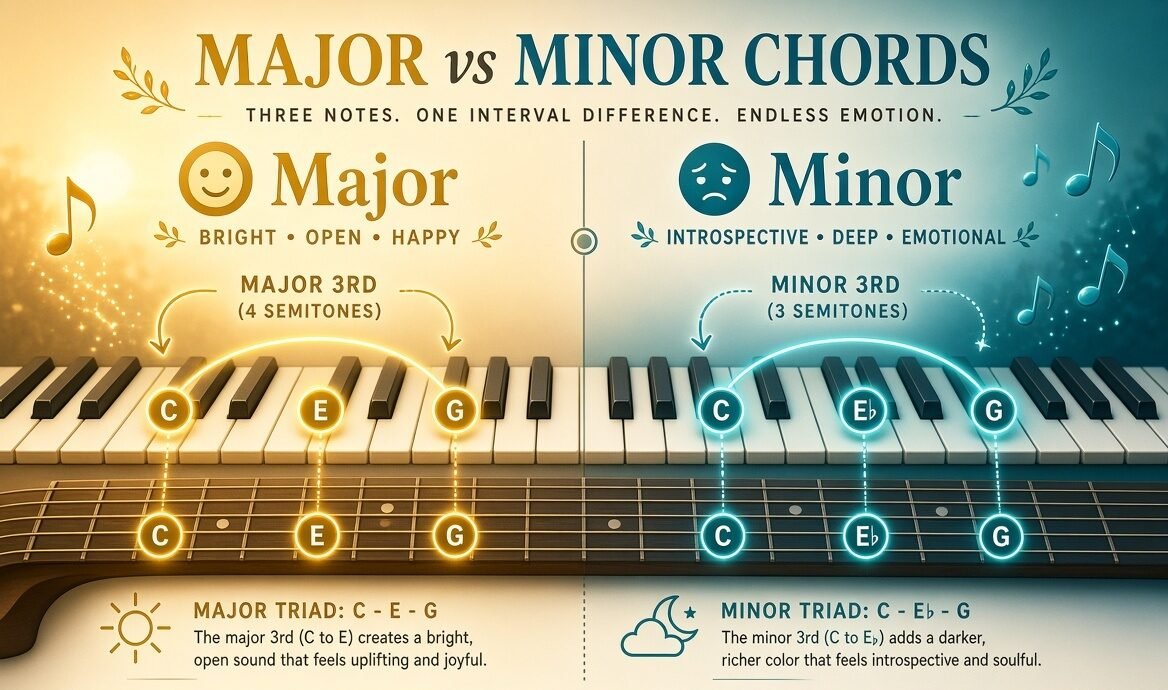
In C major this gives the classic I–IV–V progression: C – F – G
Add the relative minors nearby and you get the six most common diatonic chords (I, ii, iii, IV, V, vi).
4. Smooth Key Changes (Modulation)
Keys that are next to each other on the circle share many notes, so moving between them sounds natural. Moving farther away creates stronger contrast.
5. Transpose Songs Quickly
Want to move a song from C major to G major? Simply shift every chord one step clockwise on the circle.
Quick Reference Chart
| Starting Key | I | IV | V | Relative Minor |
|---|---|---|---|---|
| C major | C | F | G | A minor |
| G major | G | C | D | E minor |
| D major | D | G | A | B minor |
| F major | F | B♭ | C | D minor |
| A major | A | D | E | F♯ minor |
Tips for Learning and Remembering the Circle
- Print a large version and keep it near your instrument or desk.
- Practice saying the sequence clockwise and counter-clockwise daily.
- Use it while learning new songs: identify the key and mark the I–IV–V chords.
- Start every practice session by finding the key signature of a piece using the circle.
Final Thoughts
The Circle of Fifths turns abstract music theory into a practical, visual tool. It reveals why certain chords sound good together, how key signatures work, and how to move smoothly between keys. Whether you write songs, play by ear, or read sheet music, mastering this simple diagram will accelerate your understanding of harmony.
Print one, study it for a few minutes each day, and start applying it to the music you love. Once the circle becomes second nature, a whole new level of musical freedom opens up.
Keep exploring — the circle is waiting for you.