Major and minor chords are the foundation of Western harmony. Almost every song you hear is built from these two essential chord types. Understanding the difference between them is one of the fastest ways to improve your playing, songwriting, and ear training.
This guide clearly explains what major and minor chords are, how they are built, how they sound, and how to use them.
What Is a Chord?
A chord is three or more notes played together. The most basic type is a triad, which consists of three notes:
- The root (the note the chord is named after)
- The third (the note that determines major or minor quality)
- The fifth (usually a perfect fifth)
The Critical Difference: The Third
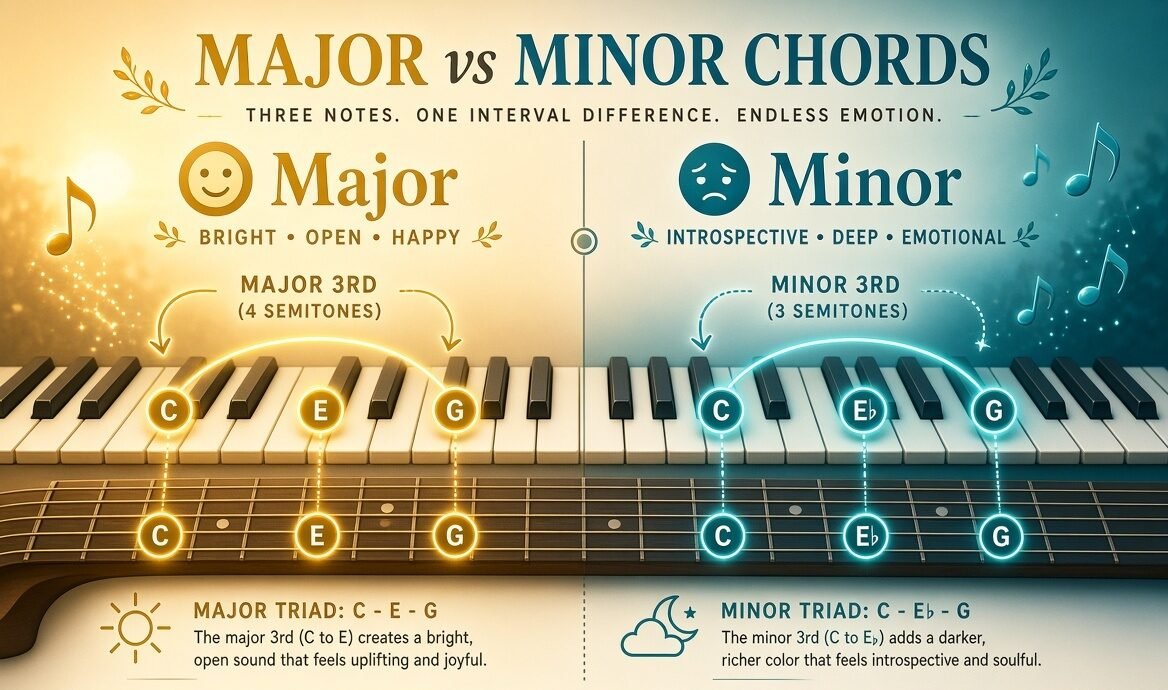
The only difference between a major and a minor triad is the third:
- Major chord → Root + Major 3rd + Perfect 5th
- Minor chord → Root + Minor 3rd + Perfect 5th
That single half-step change in the third completely transforms the emotional character of the chord.
How Major and Minor Chords Sound
| Quality | Emotional Character | Common Descriptions |
|---|---|---|
| Major | Bright, happy, stable, resolved | Joyful, triumphant, open |
| Minor | Darker, sad, emotional, tense | Melancholy, serious, introspective |
You can often identify whether a song is in a major or minor key just by listening to the quality of the main chords.
Chord Formulas
Major Triad Formula
1 – 3 – 5
(Root – Major 3rd – Perfect 5th)
Minor Triad Formula
1 – ♭3 – 5
(Root – Minor 3rd – Perfect 5th)
Easy Examples in C
C Major Chord
Notes: C – E – G
- C to E = major third
- C to G = perfect fifth
C Minor Chord
Notes: C – E♭ – G
- C to E♭ = minor third
- C to G = perfect fifth
The only change is E becoming E♭.
Building Major and Minor Chords from Any Root
Here’s a quick reference for the most common chords:
| Root | Major Chord | Minor Chord |
|---|---|---|
| C | C – E – G | C – E♭ – G |
| D | D – F♯ – A | D – F – A |
| E | E – G♯ – B | E – G – B |
| F | F – A – C | F – A♭ – C |
| G | G – B – D | G – B♭ – D |
| A | A – C♯ – E | A – C – E |
| B | B – D♯ – F♯ | B – D – F♯ |
Relative Major and Minor
Every major key has a relative minor that shares the same key signature (and many of the same chords).
- The relative minor is found by going down a minor third (three half-steps) from the major root.
Example: C major → A minor - Songs often switch between a major key and its relative minor to change mood without changing the overall collection of notes.
How to Play Them
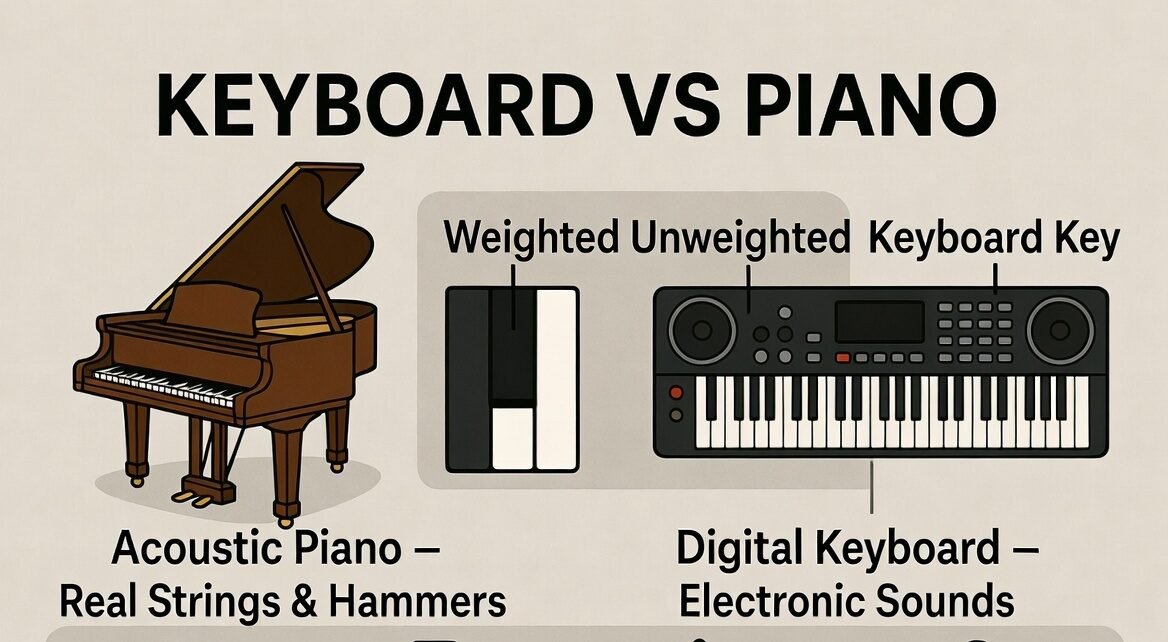
On Piano
- Major: Play the root, skip one white/black key for the major third, then skip to the fifth.
- Minor: Lower the middle note by one half-step.
On Guitar
- Most open and barre chord shapes have both major and minor versions.
- The minor shape usually involves lowering one finger by one fret compared to the major shape (for example, A major vs A minor).
Practical Uses in Music
- Major chords dominate happy, uplifting, triumphant, or peaceful music (pop choruses, folk songs, many classical pieces).
- Minor chords are used for emotional depth, sadness, tension, mystery, or seriousness (ballads, film scores, rock, blues).
- Most songs use a combination of both. A common progression is I–V–vi–IV (e.g., C–G–Am–F), which mixes major and minor for emotional contrast.
Quick Ear-Training Tip
Play a major and minor chord with the same root back-to-back (C major then C minor). Listen carefully to the middle note. Training your ear to hear the difference between a major third and a minor third is one of the most valuable skills you can develop.
Common Beginner Mistakes
- Confusing major and minor shapes on guitar
- Forgetting to lower the third when switching to minor
- Playing the fifth incorrectly (it should almost always stay a perfect fifth in basic triads)
- Not listening to the emotional quality while practicing
Final Thoughts
Major and minor chords are two sides of the same harmonic coin. The major chord feels bright and resolved; the minor chord feels deeper and more emotional. Once you understand that the only structural difference is a single half-step in the third, you gain powerful control over the mood of your music.
Practice building both types from every root note, play them back-to-back, and listen closely. Soon the difference will become second nature — and your playing, writing, and listening will improve dramatically.
Master major and minor chords, and you unlock the core language of Western music.