Rhythm is the heartbeat of music. It is what makes you tap your foot, nod your head, or dance. While melody tells you what notes to play, rhythm tells you when and how long to play them. This beginner rhythm guide explains everything you need to know to start reading, counting, and feeling rhythm with confidence.
What Is Rhythm in Music?
Rhythm is the pattern of sounds and silences in time. It is created by the duration of notes and rests, organized by a steady pulse (the beat) and grouped into measures by a time signature.
Even if you play the correct notes, wrong rhythm will make the music sound off. Strong rhythm is one of the most important skills for any beginner musician.
The Steady Beat (Pulse)
Every piece of music has a steady underlying pulse, like a ticking clock or a heartbeat. This is called the beat.
- Clap or tap along to a song at a steady speed — that is the beat.
- A metronome is a tool that clicks at a chosen speed (measured in BPM – beats per minute) to help you keep a steady tempo.
Start practicing with a metronome set to 60–80 BPM. This is a comfortable speed for beginners.
Basic Note Values
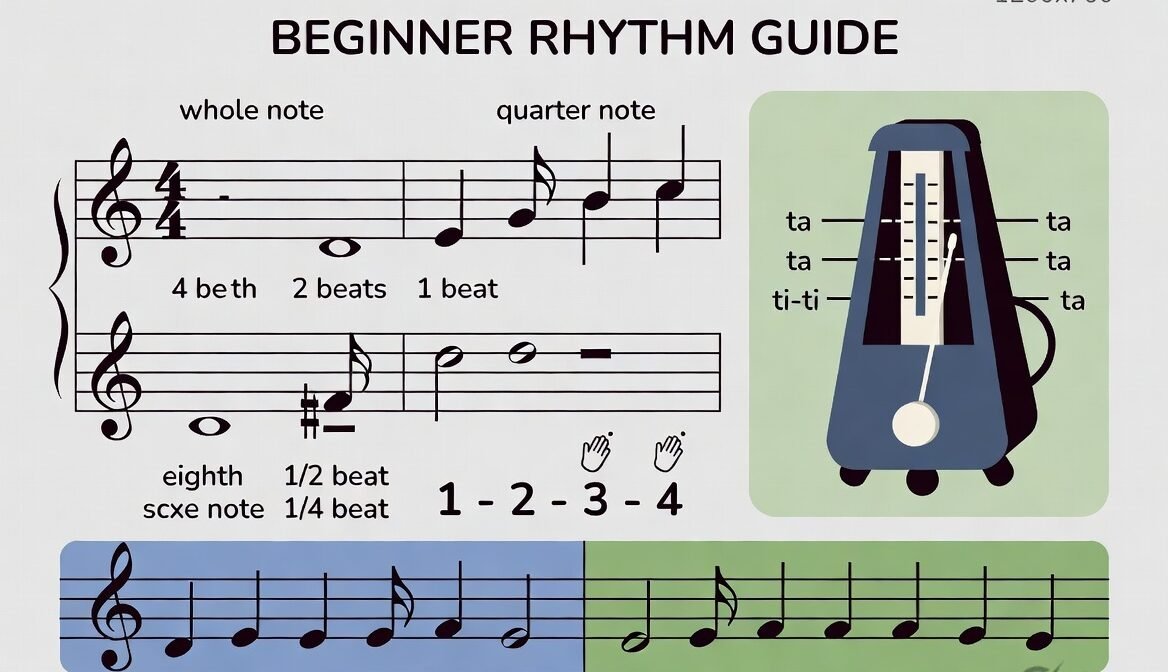
Notes tell you two things: which pitch to play and how long to hold it. Here are the most important note values for beginners:
| Note Name | Symbol Description | Duration in 4/4 Time | Counting Example |
|---|---|---|---|
| Whole Note | Open oval | 4 beats | 1 – 2 – 3 – 4 |
| Half Note | Open oval + stem | 2 beats | 1 – 2 |
| Quarter Note | Filled oval + stem | 1 beat | 1 |
| Eighth Note | Filled oval + stem + flag | ½ beat | 1 & |
| Sixteenth Note | Filled oval + stem + 2 flags | ¼ beat | 1 e & a |
Rests are silences that last the same amount of time as their matching notes (whole rest, half rest, quarter rest, etc.).
Understanding Time Signatures
The time signature appears at the beginning of a piece of music and looks like a fraction (for example, 4/4 or 3/4).
- The top number tells you how many beats are in each measure.
- The bottom number tells you which note value gets one beat.
Common time signatures for beginners:
- 4/4 (Common Time) — 4 quarter-note beats per measure. The most popular time signature in pop, rock, and classical music.
- 3/4 (Waltz Time) — 3 quarter-note beats per measure. Feels like “1-2-3, 1-2-3”.
- 2/4 — 2 quarter-note beats per measure. Often used in marches.
- 6/8 — 6 eighth-note beats per measure, usually felt in two groups of three.
How to Count Rhythm
Counting out loud is the best way to internalize rhythm.
In 4/4 time:
- Quarter notes: “1 2 3 4”
- Eighth notes: “1 & 2 & 3 & 4 &”
- Sixteenth notes: “1 e & a 2 e & a 3 e & a 4 e & a”
In 3/4 time:
- “1 2 3 | 1 2 3”
Practice clapping the rhythm while saying the counts. This builds a strong internal clock.
Simple Rhythm Patterns to Practice
Start with these easy patterns in 4/4 time (each line is one measure):
- Quarter notes:
♩ ♩ ♩ ♩
Count: 1 2 3 4 - Half notes:
♩. ♩.
Count: 1 – 2 3 – 4 - Mix of quarters and eighths:
♩ ♪♪ ♩ ♪♪
Count: 1 2 & 3 4 & - Whole note:
𝅝
Count: 1 – 2 – 3 – 4
Clap or play these patterns slowly with a metronome, then gradually increase the speed.
Tips for Beginners to Improve Rhythm
- Use a metronome every day — Even 5–10 minutes of focused practice makes a big difference.
- Subdivide — Feel the smaller beats (the “&”s) even when playing longer notes.
- Record yourself — Listening back reveals timing issues you may not notice while playing.
- Practice with songs you know — Clap or tap along to your favorite tracks.
- Start slow — Accuracy is more important than speed. Speed comes later.
- Feel the downbeat — The first beat of each measure (beat 1) is usually the strongest.
- Body movement helps — Tap your foot, nod your head, or gently sway to internalize the pulse.
Common Beginner Mistakes (and How to Fix Them)
- Rushing or dragging → Practice with a metronome and stay relaxed.
- Ignoring rests → Treat rests as important as notes. Count them carefully.
- Uneven eighth notes → Practice saying “1 & 2 &” out loud while clapping.
- Looking only at the notes, not the rhythm → Train your eyes to see the note values and stems first.
Putting It All Together
Rhythm is a skill that improves with consistent, mindful practice. Combine these elements:
- Steady beat (metronome)
- Correct note values
- Accurate counting
- Feeling the time signature
Within a few weeks of regular practice, you will notice a big improvement in your timing and musicality.
Next Steps After This Beginner Rhythm Guide
Once you feel comfortable with basic note values and 4/4 time:
- Learn dotted notes and ties
- Explore syncopation (rhythms that emphasize off-beats)
- Practice more complex time signatures
- Start reading simple rhythmic exercises from method books
Rhythm is the foundation that supports everything else in music. Master the basics in this beginner rhythm guide, and you will play with greater confidence, groove, and expression.