A beautifully tuned ukulele produces that bright, cheerful, tropical sound everyone loves. Whether you’re picking up a ukulele for the first time or you’ve been playing for years, knowing how to tune it properly is one of the most important skills you can develop. Out-of-tune strings make even the simplest chords sound wrong and can slow your progress.
This complete guide shows you exactly how to tune a ukulele using free online tools, smartphone apps, clip-on tuners, and by ear. You’ll also learn the different tunings, common mistakes to avoid, and tips to keep your instrument in tune longer.
Standard Ukulele Tunings Explained
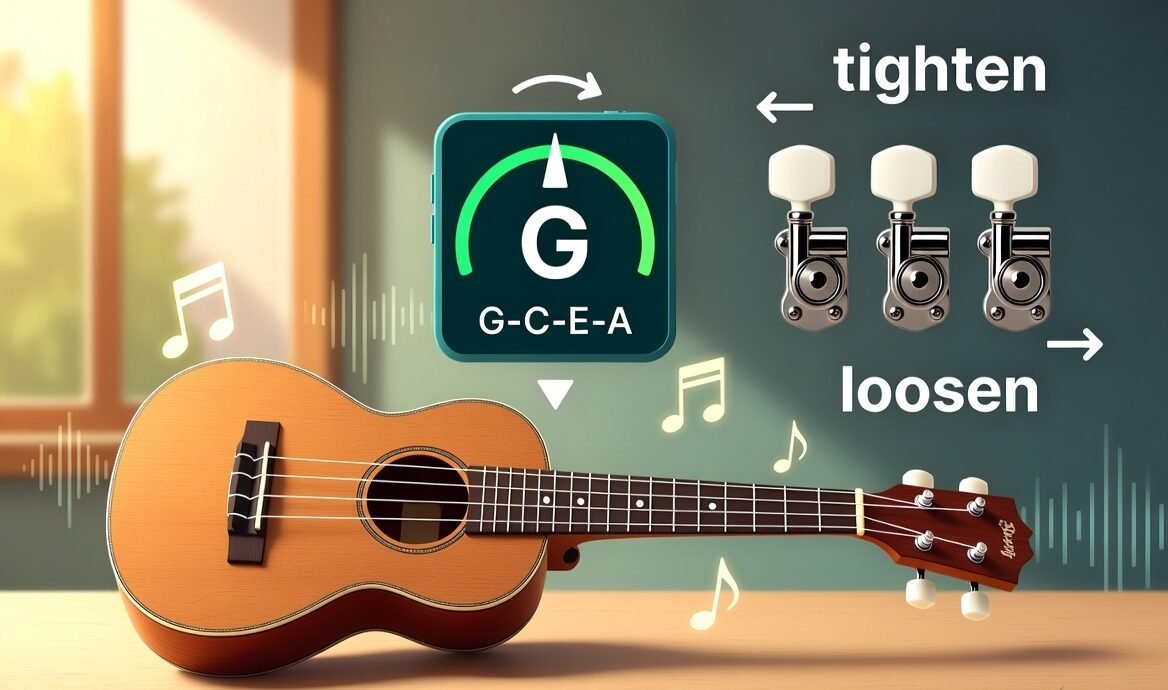
Most ukuleles use standard C tuning (also called high-G or re-entrant tuning):
- 4th string (top string, closest to your face when holding the uke): G (high G4)
- 3rd string: C (C4)
- 2nd string: E (E4)
- 1st string (bottom string): A (A4)
This is written as gCEA.
Other common tunings include:
| Tuning Name | Notes | Best For | Ukulele Size |
|---|---|---|---|
| Standard (High-G) | gCEA | Classic jangly sound, most songs | Soprano, Concert, Tenor |
| Low-G (Linear) | GCEA | Fingerstyle, more bass range | Concert, Tenor |
| Baritone | DGBE | Deeper tone, guitar-like feel | Baritone only |
| D Tuning | aDF#B | Slightly brighter, older styles | Soprano, Concert |
Always confirm which tuning your song or teacher expects before you start.
Method 1: Tune with a Free Online Ukulele Tuner (Easiest for Most People)
Online tuners are free, require no download, and work on any phone, tablet, or computer with a microphone.
Recommended websites:
- Tunerium Online Ukulele Tuner
- Fender Online Ukulele Tuner
- Fiume Ukulele Tuner
- UkuleleGuitarTuner.com
Step-by-step:
- Open one of the sites above in your browser.
- Allow microphone access when prompted.
- Select “Ukulele” and the correct tuning (usually Standard gCEA).
- Pluck the 4th string (G) clearly and hold the device near the soundhole.
- Watch the needle or display.
- Left of center = flat (too low) → gently tighten the tuning peg.
- Right of center = sharp (too high) → gently loosen the peg.
- Centered and green = in tune.
- Repeat for C, E, and A strings.
- Play all four open strings again and fine-tune if needed (string tension changes slightly as you tune).
Pro tip: Always tune up to the note. If you go past it, loosen the string below the pitch and come back up. This helps the string settle better.
Method 2: Use a Smartphone App
Popular free apps with excellent ukulele modes:
- GuitarTuna
- Fender Tune
- UkuTabs app (if available)
These work the same way as online tuners but often include extra features such as chord libraries and practice tools. Grant microphone permission and select “Ukulele – Standard” mode.
Method 3: Clip-On (Headstock) Tuner
Clip-on tuners are ideal when you’re in a noisy room or outdoors because they detect vibration instead of sound.
- Clip the tuner firmly onto the headstock.
- Turn it on and select Ukulele or Chromatic mode.
- Pluck each string one at a time.
- Adjust the pegs until the display shows the correct note centered.
Recommended models for ukulele include Snark SN-6X, KLIQ UberTuner, and Fender FT-1 Pro.
Method 4: Tune by Ear (Relative Tuning)
Once you’re comfortable, learning to tune by ear is a valuable skill.
Using the 5th-fret method (for standard gCEA):
- Tune the 4th string (G) to a reference (online tone, piano, or another instrument).
- Fret the 4th string at the 5th fret → this note should match the open 3rd string (C). Adjust the 3rd string.
- Fret the 3rd string at the 4th fret → this matches the open 2nd string (E). Adjust the 2nd string.
- Fret the 2nd string at the 5th fret → this matches the open 1st string (A). Adjust the 1st string.
You can also use reference tones from online tuners or apps while matching by ear.
Step-by-Step Visual Summary
- Start with the G string (4th string).
- Move to the C string (3rd).
- Then the E string (2nd).
- Finish with the A string (1st).
- Recheck all strings — especially the G and C, as they are most affected by overall tension.
Common Tuning Mistakes & How to Avoid Them
- Tuning in a noisy room → Use a clip-on tuner or find a quieter space.
- Plucking too softly or too hard → Use a consistent, medium pluck.
- New strings stretching → New fluorocarbon or nylon strings need frequent retuning for the first few days. Gently stretch them by pulling upward after installation.
- Over-tightening → Nylon strings can break if forced. Turn pegs slowly.
- Ignoring temperature and humidity → Ukuleles are sensitive. Keep yours in a stable environment and retune after big changes.
Tips to Keep Your Ukulele in Tune Longer
- Stretch new strings properly after installing them.
- Tune up to pitch rather than down.
- Store your ukulele in a case when not playing.
- Avoid extreme heat, cold, or humidity swings.
- Check tuning every time you pick up the instrument — even experienced players do this.
- Consider a low-G string set if you want more stability and range for fingerstyle.
Quick Troubleshooting
| Problem | Likely Cause | Solution |
|---|---|---|
| Strings keep going flat | New strings stretching | Stretch and retune often |
| One string won’t stay | Slippery peg or worn slot | Check peg tension or nut |
| Tuner jumps around | Background noise or weak mic | Move closer or use clip-on |
| Sounds okay alone but not with others | Different reference pitch | Confirm A=440 Hz |
Final Thoughts
Tuning a ukulele is simple once you practice it a few times. Start with a free online tuner or app — they give instant visual feedback and remove the guesswork. As you improve, combine methods and eventually develop your ear.
A well-tuned ukulele makes practice more enjoyable, chords ring clearly, and songs sound the way they’re meant to. Take thirty seconds to tune every time you play, and you’ll hear (and feel) the difference immediately.
Now pick up your ukulele, open a tuner, and get those strings singing. Happy strumming!